Now that Kevin Warsh has been confirmed as the new chair of the Federal Reserve, President Trump may see his desire for lower interest rates finally satisfied.
Low interest rates may be good for companies needing to borrow funds, but it may be a negative for fixed income investors, as well as retirees living off interest from their investments.
Solving the Low Interest Rate Problem Facing Fixed Income Investors
The Strategy Shares Nasdaq 7HANDL Index ETF (HNDL) pays a monthly distribution on HNDL shares at a target rate that represents an annualized payout of approximately 7.0% on the fund’s per share net asset value on the date of a distribution’s declaration. All or a portion of a distribution may consist of a return of capital from the original investment and the distribution rate may be modified at any time. The ETF has not missed a monthly distribution since its January 2018 launch, according to Strategy Shares.
Yield Comparisons
To provide yield comparisons across the market, the S&P 500 Index pays an annual dividend yield of 1%, while the U.S. Treasury’s 10-year bond currently pays a yield of 4.57%. However, it is our belief that it offers little potential for growth (unlike the stock market) and bond yields have the potential to fall if the Fed reduces interest rates. While HNDL is managed against the 7HANDL Index, this data is provided to show the differences across all spectrums of the investment universe.
Stacks Up Well Against Annuities and CEFs
One raison d’être for HNDL is to provide income to retirees without locking up capital. Annuities pay a consistent distribution, but you need to lock up a significant amount of money for the rest of your life. HNDL is an exchange-traded fund (ETF). All ETFs are liquid. You can access the capital by selling at any time.
The monthly annuity payment is determined by many factors, age, gender, and the interest rate when you buy the annuity. Annuities have interest-rate risk, so when you buy matters. Buying when rates are low means locking in lower payments for life.
A single-premium immediate annuity, the most common income annuity, pays income for life. If you die before receiving your full principal back, the insurer keeps the remainder. Annuities also often charge management fees of 1% to 4% of assets, plus high sales commissions. HNDL has a 0.95% expense ratio and is available on no-commission platforms.
Look Under the Hood
HNDL is a fund of funds. It holds ETFs in two portfolios that each make up approximately 50% of the fund: The Core Portfolio and the Dorsey Wright Explore Portfolio are both a mix of bond and equity funds. The passive Core Portfolio holds the Vanguard Total Bond Market Index Fund (BND), the Vanguard S&P 500 ETF (VOO), the Invesco NASDAQ 100 ETF (QQQM), and others. The Core Portfolio consists of 60% bond funds, with large-cap stocks the other 40%.
The active Dorsey Wright Explore Portfolio leverages rules-based technical analysis—primarily Point & Figure charting and Relative Strength (momentum) modeling—to construct a tactical asset allocation designed to outperform broad benchmarks.
The portfolio holds 12 ETFs that track a variety of income-producing asset classes. These asset classes can typically pay high dividends, such as master limited partnerships (MLPs), real estate investment trusts (REITs), utilities, covered calls, as well as a variety of equity funds, including preferred dividends. The portfolio also includes high-yield bond funds, municipal bond funds, and mortgage-backed securities. This diversified strategy is designed to maximize risk-adjusted returns and makes it easier for the ETF to fund its distribution.
A goal of this framework is to capture the market’s upside during bull phases, then pivot to defensive assets during market drawdowns. It does this with a monthly rebalance. If you were to invest in a dividend fund with a higher yield, one holding 100% equities, you may run the risk of disaster in retirement because equities can have much more volatility. In addition, a dividend fund’s payout isn’t guaranteed. It could be cut at any time.
“It’s a broadly diversified portfolio that takes care of all the rebalancing, so it’s positioning you in the asset classes that are doing best for that point in time,” said David Miller, HNDL’s portfolio manager.
Designed with Retirees in Mind
There are nearly 69 million baby boomers living in the U.S., and more than 10,000 retire every day, according to the American Association of Retired Persons (AARP). Retirees need a dependable and consistent distribution to fund their retirements.
One common rule for withdrawing money during retirement is the “4% Rule.” The strategy recommends withdrawing 4% of your portfolio each year. It’s designed to preserve capital. HNDL, which is designed to generate consistent cash flow, seeking to pay out 7% of your investment every year. The monthly payout equals 1/12 of 7%, or 0.583%, of the then current NAV.
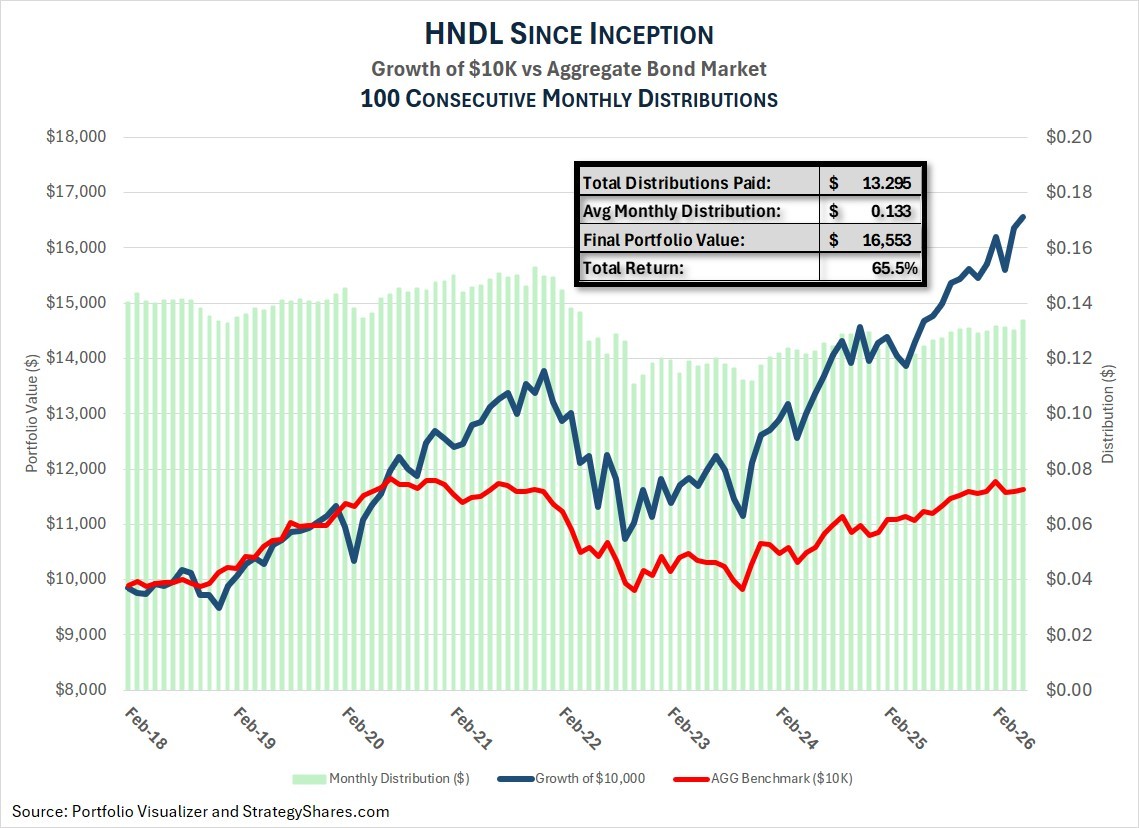
This chart shows the monthly distributions since the fund’s inception. The light green lines show the monthly distributions, which average 13.3 cents per share. If you own 100 shares, that would be $13.30 a month. The total distribution paid per share since the fund launched eight years ago is $13.295. This means if you had invested $10,000 at the launch, and reinvested the dividends, your portfolio value would be close to $16,500, for a 65% total return.
The above chart shows the monthly distributions since the fund’s inception. The light green lines show the monthly distributions, which average 13.3 cents per share. If you own 100 shares, that would be $13.30 a month. The total distribution paid per share since the fund launched eight years ago is $13.295. This means if you had invested $10,000 at the launch, your portfolio value would be close to $16,500, for a 65.5% total return.
How They Do It
The distribution is engineered not improvised. The distribution has three components, interest from bond funds, dividends from other asset classes, and when needed, return of capital. Return of capital (ROC) uses some of your initial investment for the payout. It uses ROC about 50% of the time, when the income produced by the ETF isn’t enough to cover the payout. Unrealized gains in the equity funds can offset some or all of this ROC.
Lawrence Carrel is the author of ETFs for the Long Run and has written about ETFs for Forbes, Kiplinger’s Magazine, SmartMoney, and Investor’s Business Daily.
Notice and Important Fund Disclosures
Past performance is not a guarantee of future results.
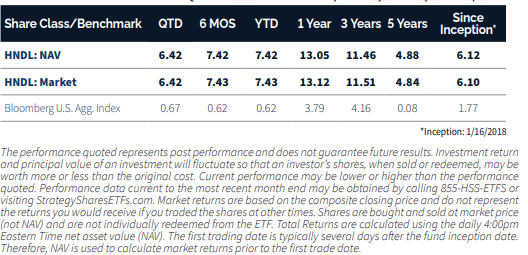
Performance (%) Ending June 30, 2026
Annualized if greater than a year
Investors should carefully consider the investment objectives, risks, charges and expenses of the Nasdaq 7HANDL Index ETF. This and other important information about the Fund is contained in the full or summary prospectus, which can be obtained by calling (855) HSS-ETFS (855-477-3837) or at www.strategysharesetfs.com. The Strategy Shares are distributed by Foreside Fund Services, LLC, which is not affiliated with Rational Advisors, Inc., or any of its affiliates. Gross expense ratio of the Fund is 0.95%.
Shareholders should not assume that the source of a distribution from the Fund is net profit. Shareholders should note that return of capital will reduce the tax basis of their shares and potentially increase the taxable gain, if any, upon disposition of their shares.
Investments involve risk, including possible loss of principal. Investment in a fund of funds is subject to the risks and expenses of the underlying funds. The use of leverage can magnify the potential for gain or loss and amplify the effects of market volatility on the Fund’s shares. The value of the Fund may decrease in response to the activities and financial prospects of an individual security or group of securities in the Fund’s portfolio. The performance of the Fund may be subject to substantial short-term changes, as well as the risks inherent to investing in ETFs. To the extent the Fund invests in ETFs comprised of the stocks of large-cap companies, the Fund may be subject to additional risks, including that such companies may be less able to adapt to changing market conditions or may have more limited growth potential. Investing in US aggregate fixed income ETFs is subject to credit, prepayment and interest rate risk of the underlying securities which comprise the ETFs; a rise in interest rates generally causes a decline in the value of fixed income securities. Investing in ETFs in various alternative U.S. asset categories may subject the Fund to greater volatility than investment in securities in traditional asset categories. The Fund is subject to regulatory change and tax risks; changes to current rules could increase costs associated with an investment in the Fund. These factors may affect the value of your investment.