Every company wants growth. Far fewer can keep competitors from taking the profits that growth creates.
That distinction separates an exciting industry from a potentially exceptional investment. A market can expand rapidly while the businesses serving it struggle with price wars, rising costs and products that become interchangeable. For shareholders, growing demand is only half the equation. The other half is how much value a company can retain.
The Strategy Shares Monopoly ETF (MPLY) is built around that second question. Rather than simply buying into an attractive industry, the fund seeks businesses with competitive advantages that may help them defend profitability and compound value over time. [1]
Why the Winners Matter So Much
The argument starts with an uncomfortable fact about stock investing: wealth creation is remarkably uneven.
A study published in the Financial Analysts Journal examined more than 64,000 global stocks from January 1990 through December 2020. The top-performing 2.4% of companies accounted for all $75.7 trillion of net stock-market wealth creation above Treasury bills. The remaining companies, collectively, matched the Treasury-bill benchmark. That does not mean every other stock lost money. It means a small minority supplied the market’s net wealth creation. [2]
The finding supports broad diversification, because tomorrow’s winners are difficult to identify. It also raises a useful question for investors seeking something beyond market exposure: what characteristics might help a business become an enduring winner?
Corporate profitability offers another clue. McKinsey’s research on 5,750 large companies found that the top 10% captured 80% of positive economic profit—profit above the cost of capital. The middle 60% generated approximately zero economic profit on average. The study examined companies with more than $1 billion in annual revenue over 1994–2016. [3]
Neither study proves that MPLY will identify future winners. Both explain why the economics of the underlying businesses deserve attention.
A Monopoly Does Not Have to Mean One Supplier
MPLY’s name is deliberately provocative, but its investment approach is broader than the dictionary definition of monopoly. It also considers oligopolies: markets where a small group of companies holds strong competitive positions. The fund looks for attributes including brand strength, patents, barriers to entry, pricing power and network effects. [1]
Consider the difference between a product customers can replace tomorrow and a service embedded in how they operate. The first supplier must continually defend its price. The second may offer enough value, reliability or integration that switching becomes costly or inconvenient. That advantage is what investors commonly call an economic moat. [4]
For shareholders, the potential benefits reinforce one another. Pricing power can help protect margins when costs rise. Scale can lower the cost of serving additional customers. Strong returns on capital can leave more money available for reinvestment, acquisitions or shareholder distributions. None eliminates competition; each can improve a company’s ability to withstand it. [3][4]
The attraction is not merely being large. It is having a reason to remain profitable.
Looking for Evidence, Not Just Famous Brands
A compelling business story is not enough. MPLY combines qualitative assessments of competitive advantage with financial analysis, including revenue growth, profit margins, returns on investment and equity, leverage, and earnings per share. Its sub-adviser, Rareview Capital, can sell companies when their competitive attributes or financial appeal deteriorate. [5]
That distinction matters. A celebrated brand can lose relevance. A dominant platform can face a better alternative. McKinsey found that nearly half of its superstar companies lost that status during each business cycle. Ownership of yesterday’s winner is not a substitute for ongoing research. [3]
Where the Thesis Meets the Income Statement
Microsoft, a disclosed MPLY holding as of October 31, 2025, offers a concrete example. In its fiscal year ended June 30, 2026, the company reported $331.8 billion in revenue and $155.2 billion in operating income. That translates into an operating margin of approximately 46.8%, while revenue grew 18%. Those are measurable financial results, not simply a claim that customers like its products. [12][13]
The company also reported $35.6 billion in research and development spending that year. That illustrates an important possibility: a profitable incumbent can use its earnings capacity to fund the innovations that help sustain its position. It is a more demanding investment thesis than simply assuming today’s leader stays ahead forever. [13]
An Investment Process in One Trade
MPLY packages this approach in an actively managed ETF that typically expects to hold approximately 75 to 125 companies. Its opportunity set includes U.S. and non-U.S. businesses trading on U.S. exchanges, generally with market capitalizations of at least $2 billion. Holdings are predominantly weighted by company size, with discretion over final allocations. [5]
For investors, the practical benefit is implementation. They can obtain a portfolio organized around competitive advantage without independently researching, weighting and monitoring dozens of companies. The investment thesis remains focused even though the businesses can operate in different industries. Investors are not buying immunity from change. They are buying a researched view of which businesses have the resources and competitive position to adapt to it successfully.
An Encouraging Start, With Perspective
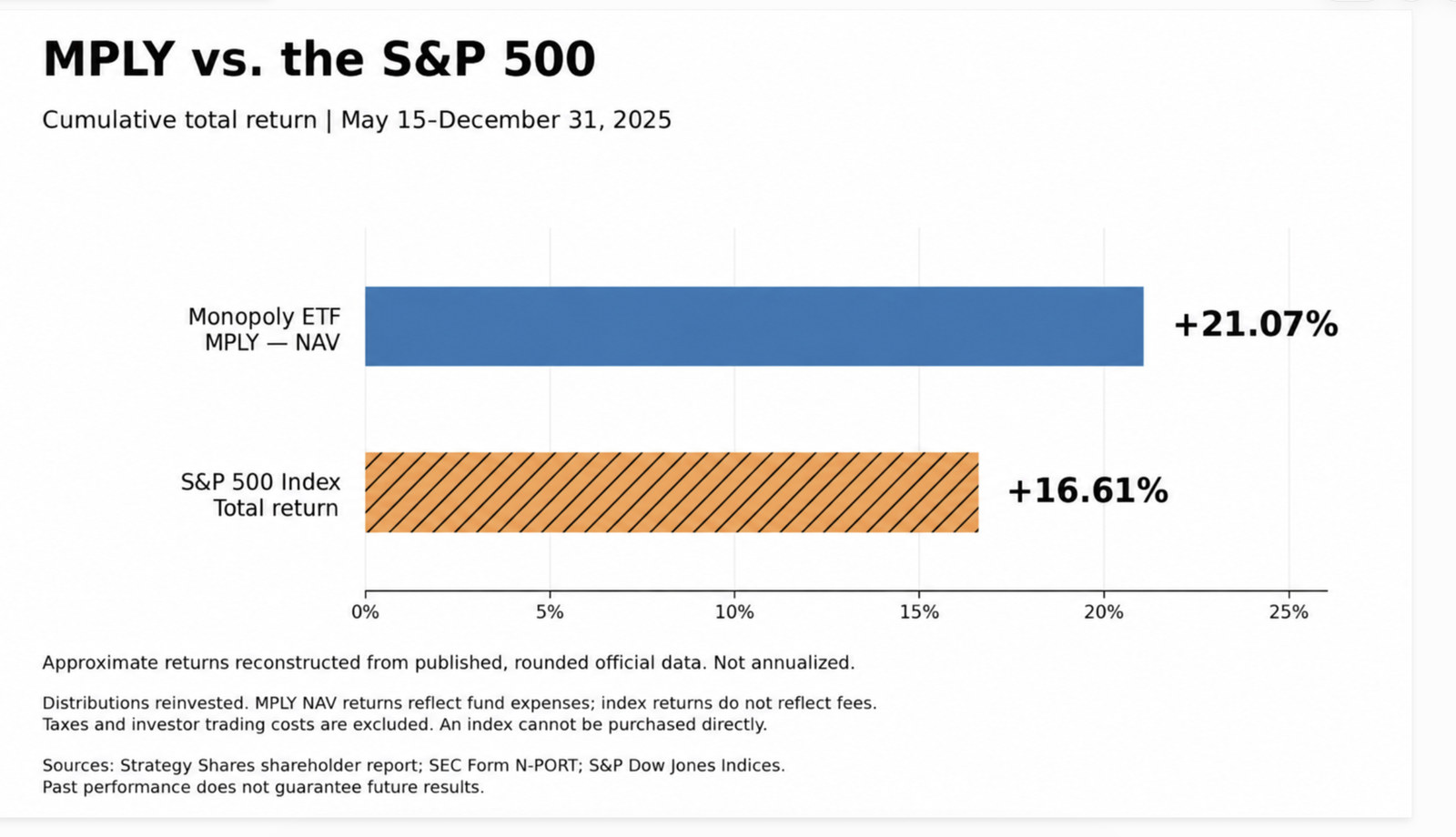
From its May 15, 2025, inception through December 31, 2025, MPLY’s cumulative NAV total return was approximately 21.1%, compared with 16.6% for the S&P 500 Total Return Index. A hypothetical $10,000 investment therefore grew to approximately $12,110 versus $11,660. The comparison is calculated from published, rounded official data and assumes reinvestment of distributions. [7][8][9][10]
The performance data quoted above represents past performance. Past performance is not a guarantee of future results. Investment return and value of the ETF shares will fluctuate so that an investor’s shares, when sold or redeemed, may be worth more or less than their original cost. Current performance may be lower or higher than performance data quoted.
That roughly 4.5-percentage-point advantage is an encouraging opening chapter, not a verdict on the strategy. The period covers less than eight months, not a full market cycle. It does not establish how MPLY will behave through a prolonged downturn or whether its initial advantage will persist.
A Deliberate Tilt, Not a Free Lunch
A broad-market index and MPLY serve different purposes. The S&P 500 spans 500 leading companies across the U.S. market; MPLY selects a smaller portfolio around a particular set of business characteristics. Many familiar companies can appear in both. The distinction is not exclusive access to famous names, but the selection process, position sizes and businesses left out. [5][14]
MPLY’s annual expense ratio is 0.79% (as of September 1st, 2026). It is legally non-diversified and can have substantial sector exposure. Concentration, foreign securities, valuation changes and management decisions can all affect returns. A strong business can still be a disappointing investment when expectations embedded in its stock price are too high. [11]
One possible role is a satellite allocation beside a broad-market core. That allows an investor to express a conviction about competitive advantage without making one investment philosophy responsible for an entire equity portfolio. The appropriate allocation still depends on existing holdings, objectives and tolerance for losses.
The portfolio question is therefore not whether dominant businesses are attractive in the abstract. It is whether an investor wants to emphasize them, accepts the associated risks and believes the research process justifies its cost.
For that investor, MPLY offers a clearly articulated proposition: focus on companies that may retain more of the value they create, rather than treating growth alone as the investment case. [1]
The next breakthrough will always command attention. The business that competitors struggle to replace may deserve just as much. That is the opportunity MPLY asks investors to examine: not simply who can grow, but who can keep the rewards.
Important investment information
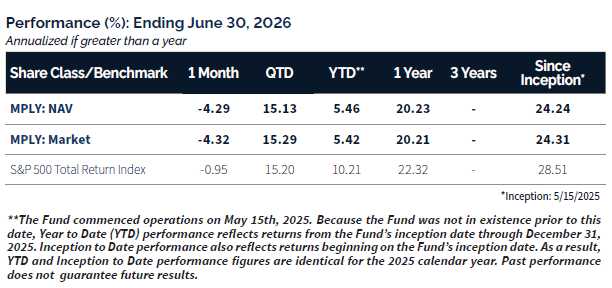
The performance quoted represents past performance and does not guarantee future results. Investment return and principal value of an investment will fluctuate so that an investor’s shares, when sold or redeemed, may be worth more or less than the original cost. Current performance may be lower or higher than the performance quoted. Performance data current to the most recent month end may be obtained by calling 855-HSS-ETFS or visiting strategysharesetfs. com.
Risk Considerations:
Past performance is not a guarantee of future results.
Investors should carefully consider the investment objectives, risks, charges and expenses of the Monopoly ETF. This and other important information about the Fund is contained in the full or summary prospectus, which can be obtained by calling (855) HSS-ETFS (855-477-3837) or at www.strategysharesetfs.com. The Strategy Shares are distributed by Foreside Fund Services, LLC, which is not affiliated with Rational Advisors, Inc., Rareview Capital LLC, or any of their affiliates.
Equity Securities Risk. The price of common stock in the Fund’s portfolio will fluctuate based on actual or perceived changes in a company’s financial condition and on market and economic conditions. Investor perceptions are based on various and unpredictable factors, including expectations regarding government, economic, monetary and fiscal policies; inflation and interest rates; economic expansion or contraction and global or regional political, economic and banking crises.
Foreign Securities Risk. Since the Fund’s investments may include ADRs, the Fund is subject to risks beyond those associated with investing in domestic securities. The value of foreign securities is subject to currency fluctuations.
Management Risk. The investment strategies and models employed by the Sub-Advisor in selecting investments and asset allocations for the Fund may not result in an increase in the value of your investment or in overall performance equal to other similar investment vehicles having similar investment strategies.
New Fund Risk. The Fund is a relatively new fund with limited history of operations as an ETF for investors to evaluate. If the Fund is unable to achieve an economic size, expenses will be higher than expected and the Fund might close, which could produce adverse tax consequences for shareholders.
Source register
[1] Cboe, Monopoly ETF (MPLY): listed product and investment strategy.
[2] Bessembinder et al., “Long-Term Shareholder Returns: Evidence from 64,000 Global Stocks,” Financial Analysts Journal (2023).
[3] McKinsey, “What Every CEO Needs to Know About Superstar Companies” (2019).
[4] S&P Dow Jones Indices, “A Systematic Approach for Identifying Companies with Economic Moats,” research overview (August 2024).
[5] Strategy Shares Monopoly ETF, Summary Prospectus: principal strategies and security selection.
[7] Strategy Shares, Annual Shareholder Report, April 30, 2026: MPLY growth-of-$10,000 values for May 15 and October 31, 2025.
[8] MPLY, SEC Form N-PORT, reporting date January 31, 2026, Item B.5: November and December 2025 fund returns.
[9] S&P Dow Jones Indices, U.S. Equities Market Attributes, November 2025: S&P 500 monthly total return.
[10] S&P Dow Jones Indices, U.S. Equities Market Attributes, December 2025 (January 5, 2026): December total return.
[11] Strategy Shares Monopoly ETF, Prospectus: annual expenses and principal risks.
[12] MPLY, SEC Form N-PORT, reporting date October 31, 2025: Microsoft Corporation holding.
[13] Microsoft, FY2026 fourth-quarter and full-year earnings release (July 29, 2026).
[14] S&P Dow Jones Indices, “S&P 500: The Gauge of the U.S. Large-Cap Market.”